


Blog
Magic Mushroom Gummies vs. Dried Mushrooms: What’s the Difference?

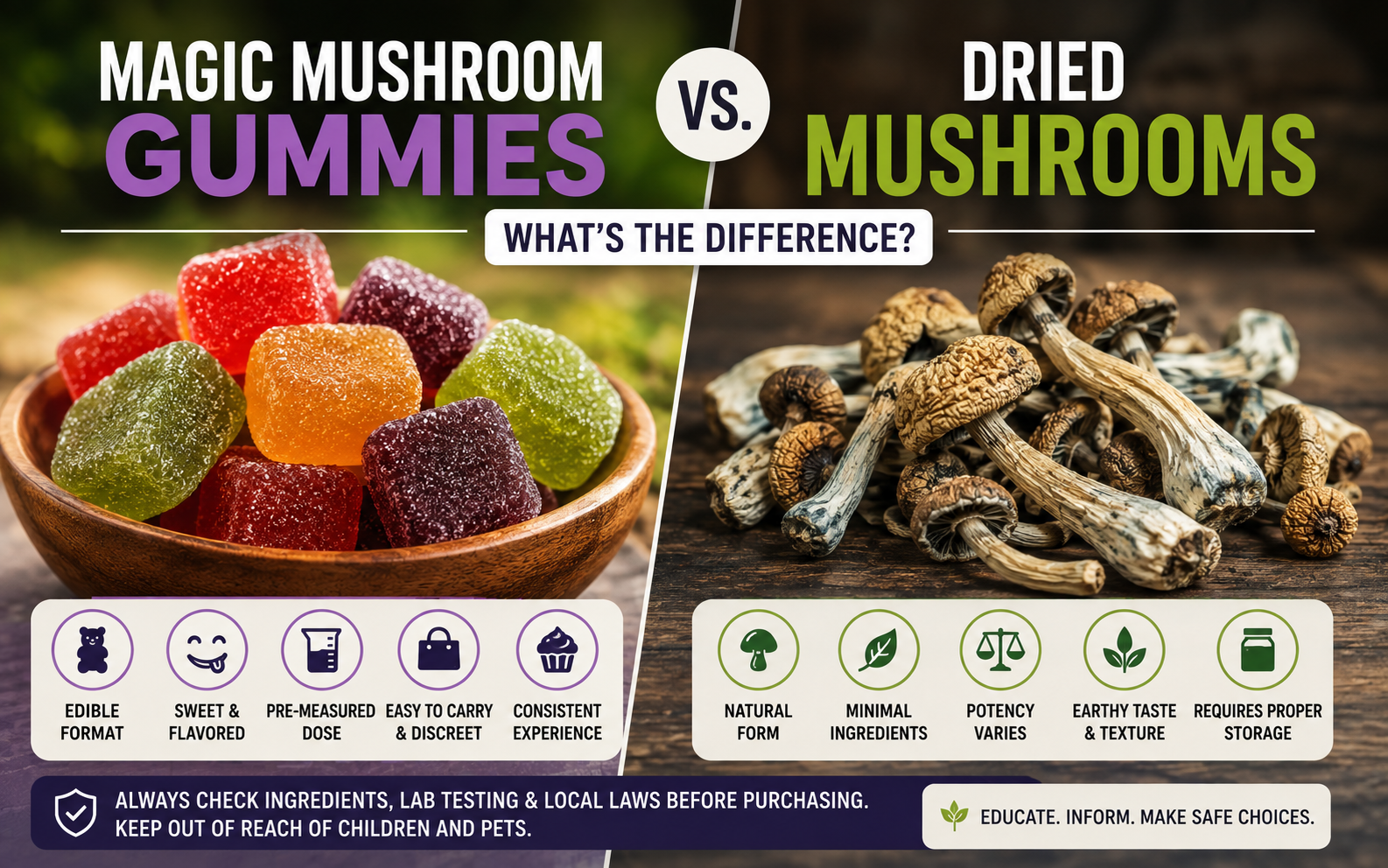
Magic mushrooms have traditionally been associated with dried mushrooms, but gummies have introduced a very different format for products marketed around psychedelic mushrooms. At first glance, the two may seem similar because they can be associated with the same active compound, psilocybin. However, their ingredients, appearance, labeling, storage, consistency, and overall experience can differ considerably.
If you are researching magic mushroom gummies or dried mushrooms for the first time, understanding these differences is important. The name or appearance of a product alone does not tell you what it contains.
This guide explains the key differences between magic mushroom gummies and dried mushrooms, what consumers should look for on product labels, and why product verification matters.
What Are Dried Magic Mushrooms?
Dried magic mushrooms are mushrooms from species that naturally contain psychedelic compounds, primarily psilocybin and psilocin.
After harvesting, mushrooms may be dried to reduce their moisture content. The dried material retains the naturally occurring compounds found in the mushroom, although the concentration can vary.
The appearance of dried mushrooms can also vary depending on the species. They may have visible caps and stems and can have a distinctive earthy mushroom aroma.
One important point is that dried mushrooms are not necessarily standardized products. The amount of psilocybin can vary between species, individual mushrooms, growing conditions, and even different parts of the same mushroom.
What Are Magic Mushroom Gummies?
Magic mushroom gummies are edible gummy products marketed as containing mushroom-derived or psychedelic ingredients.
Unlike dried mushrooms, gummies are manufactured food-style products. They may contain gelatin or pectin, sweeteners, flavorings, colors, acids, and other ingredients depending on the formulation.
However, the phrase “magic mushroom gummy” does not automatically mean that a product contains psilocybin.
Some mushroom gummies contain functional mushroom extracts such as Lion’s Mane, Reishi, or Cordyceps. Others may be marketed as psychedelic gummies and contain different psychoactive ingredients.
This is why reading the ingredient information is more important than relying on the product name.
Magic Mushroom Gummies vs. Dried Mushrooms at a Glance
| Feature | Magic Mushroom Gummies | Dried Mushrooms |
|---|---|---|
| Format | Chewable edible | Dried mushroom material |
| Appearance | Usually colorful, flavored gummies | Whole or broken dried mushrooms |
| Ingredients | May contain mushroom extracts plus flavoring and other ingredients | Primarily dried mushroom material |
| Taste | Usually sweet or flavored | Typically earthy or mushroom-like |
| Labeling | Usually packaged with an ingredient list | May have limited product information depending on source |
| Active compound | Depends on the specific product | Naturally occurring compounds vary |
| Consistency | May be formulated into individual pieces | Natural variation is common |
| Storage | Depends on manufacturer instructions | Requires appropriate storage to maintain quality |
| Product verification | Ingredient and manufacturer information are important | Species and source information are important |
1. The Biggest Difference Is the Format
The most obvious difference is physical form.
Dried mushrooms are the original mushroom itself after moisture has been removed. Gummies are manufactured edibles created using a gummy base and other ingredients.
This difference affects almost everything about the product, including appearance, taste, portability, packaging, and labeling.
Dried mushrooms retain recognizable mushroom characteristics. Gummies can look like ordinary candy, making it particularly important to store them responsibly and keep them away from children and pets.
2. Ingredients Can Be Very Different
Dried mushrooms generally consist of mushroom material.
Gummies can contain a much longer list of ingredients. Depending on the product, this may include:
- Mushroom extracts
- Sweeteners
- Natural or artificial flavors
- Fruit ingredients
- Pectin or gelatin
- Citric acid
- Food coloring
- Other botanical or functional ingredients
This means consumers should never assume that two products with “mushroom” in their names contain the same active compounds.
If a product is marketed as a psychedelic gummy, check whether the manufacturer clearly identifies the active ingredient rather than relying on the product title alone.
3. Potency and Consistency Can Differ
Natural mushrooms can vary considerably in their concentration of active compounds. Species, growing conditions, maturity, storage, and individual mushroom characteristics can all contribute to variation.
A commercially manufactured edible may be formulated into individual pieces with a stated amount of an ingredient. However, the reliability of that information depends on the manufacturer and the quality of its testing and production processes.
This is one reason third-party laboratory testing and transparent labeling can be important when evaluating products.
A label that simply says “magic mushroom” without identifying the active ingredients provides considerably less useful information than a transparent ingredient panel.
4. Taste and Texture
Taste is another obvious difference.
Dried mushrooms typically have an earthy, woody, or mushroom-like flavor. Their texture can also be dry or fibrous.
Gummies are designed to have a familiar chewy texture and may be flavored with fruit or other sweet flavors.
For consumers who dislike the natural taste of mushrooms, the gummy format may seem more approachable. However, a more appealing taste does not change the potential effects or risks associated with psychoactive ingredients.
5. Appearance Can Affect Safety
Dried mushrooms generally look like mushrooms, making them relatively easy to distinguish from conventional food.
Gummies can look very similar to ordinary candy.
This creates an important storage consideration. Products containing psychoactive ingredients should be clearly labeled and stored securely away from children, pets, and anyone who could mistake them for regular sweets.
A colorful package or candy-like appearance should never be taken as an indication that a product is harmless.
6. Product Labeling Matters
When comparing gummies with dried mushrooms, labeling deserves particular attention.
For a packaged product, consumers should look for:
- Full ingredient information
- The identity of the active ingredient
- Manufacturer or supplier information
- Serving information
- Batch or lot information where applicable
- Testing information where available
- Storage instructions
- Relevant warnings
Be cautious with products that make vague claims without explaining what is actually inside them.
“Mushroom gummy” can describe a wide range of products, and two gummies from different manufacturers may have completely different formulations.
7. Effects Are Not Determined by the Format Alone
It is easy to assume that gummies and dried mushrooms produce completely different experiences simply because they look different. The format itself, however, is only one factor.
When a product genuinely contains psilocybin, the effects are related to the active compound and individual circumstances rather than simply whether the product is a mushroom or a gummy.
Health Canada notes that psilocybin can produce changes in perception, mood, sensory experiences, thoughts, and the perception of time. Effects can also include anxiety, panic, confusion, nausea, increased heart rate, and increased blood pressure.
Individual experiences can vary significantly.
8. Gummies May Contain Something Other Than Psilocybin
This is one of the most important differences consumers should understand.
The term “magic mushroom gummies” is sometimes used broadly online. Some products marketed using similar terminology may contain functional mushrooms or other ingredients rather than psilocybin.
A product’s marketing language is therefore not enough to determine its contents.
Before assuming a gummy contains psilocybin, examine the actual ingredient information and the manufacturer’s documentation.
This distinction is especially important when comparing a gummy with dried mushrooms that are known to belong to a psilocybin-containing species.
9. Legal Considerations in Canada
Canadian laws surrounding psilocybin are an important part of this discussion.
Health Canada currently classifies psilocybin and psilocin as controlled substances. It states that the sale, possession, and production of magic mushrooms containing these substances are illegal unless specifically authorized.
There are limited legal pathways involving mechanisms such as authorized clinical research and specific exemptions.
Therefore, consumers should not assume that a product is legal simply because it appears on a website or is advertised online. Laws and regulatory requirements can also change, so current information from official Canadian authorities should be checked before making decisions involving psilocybin products.
Which One Is Better?
There is no universal answer to whether gummies or dried mushrooms are “better.”
They are different product formats with different characteristics.
Someone researching dried mushrooms may be interested in the natural mushroom material and its identifiable appearance. Someone researching gummies may be more interested in the edible format, flavor, and packaged presentation.
The more useful question is not simply which format looks more appealing. Instead, consider:
What does the product actually contain?
Is the active ingredient clearly identified?
Is the manufacturer transparent about its ingredients and testing?
Are the relevant warnings clearly provided?
Is the product legal and authorized where you live?
These questions are more meaningful than choosing based solely on appearance or marketing language.
Magic Mushroom Gummies vs. Dried Mushrooms: Key Takeaway
Magic mushroom gummies and dried mushrooms may be associated with the same psychedelic compound, but they are fundamentally different product formats.
Dried mushrooms are natural mushroom material, while gummies are manufactured edibles that may contain mushroom extracts, psilocybin, functional mushrooms, or other ingredients depending on the product.
The biggest differences involve format, ingredients, labeling, taste, consistency, appearance, and product transparency.
Most importantly, never assume that a product contains psilocybin simply because it is marketed as a “magic mushroom” or “shroom” product. Check the actual ingredients and available testing information.
For anyone researching psychedelic mushroom products, informed decisions start with understanding what is actually in the product and being aware of the applicable laws and safety considerations.
Frequently Asked Questions
Are magic mushroom gummies the same as dried magic mushrooms?
Not necessarily. They are different formats, and their ingredients can vary. A gummy marketed as a mushroom product may contain psilocybin, functional mushroom extracts, or other ingredients.
Do all mushroom gummies contain psilocybin?
No. Many mushroom gummies contain functional mushrooms or mushroom extracts without psilocybin. Always check the ingredient information.
Are dried mushrooms more natural than mushroom gummies?
Dried mushrooms are the original mushroom material with moisture removed. Gummies are manufactured products containing additional ingredients. However, “natural” does not automatically mean safer.
Why do mushroom gummies taste different from dried mushrooms?
Gummies are generally formulated with sweeteners and flavoring ingredients, while dried mushrooms naturally have an earthy mushroom flavor.
How can I tell what is in a mushroom gummy?
Start with the complete ingredient list and product information. Look for the specific mushroom species or active compound, manufacturer information, testing details, and relevant warnings.
Are magic mushroom gummies legal in Canada?
Psilocybin and psilocin are controlled substances in Canada. Health Canada states that activities involving magic mushrooms containing these substances are illegal unless specifically authorized. Always consult current Canadian regulatory information for the latest requirements.
Can mushroom gummies look like ordinary candy?
Yes. Many gummies have a candy-like appearance. Products containing psychoactive ingredients should therefore be clearly labeled and stored securely away from children and pets.
What should I check before choosing a mushroom product?
Pay attention to the ingredients, active compounds, manufacturer information, testing documentation, labeling, warnings, storage requirements, and applicable laws in your location.
Final Thoughts
The growing interest in mushroom gummies has created more choices for consumers, but it has also made product information more important than ever.
Whether you are comparing gummies with dried mushrooms or simply learning about psychedelic mushroom products, take the time to understand the ingredients rather than relying on names, packaging, or promotional claims.
A clear label, transparent manufacturer, reliable testing information, and awareness of Canadian regulations can help you distinguish between products and make better-informed decisions.