Get Free Express Shipping when you place an order over $150





Psilocybin Gummies: Ingredients, Product Labels and What Consumers Should Know

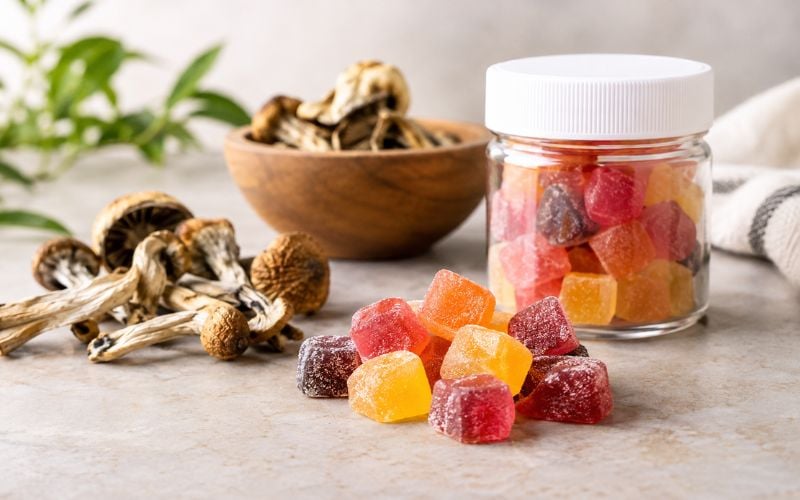
Psilocybin gummies have attracted attention as an alternative to traditional mushroom products. Their familiar candy-like appearance can make them seem similar to ordinary confectionery, but products marketed as psilocybin gummies raise important questions about ingredients, chemical composition, labeling accuracy, and safety.
Understanding these products requires looking beyond the packaging. A colorful label, a stated milligram amount, or a claim that a product contains a particular mushroom extract does not independently establish what is inside the gummy or how consistently it was manufactured.
For consumers researching mushroom gummies, the most useful starting point is to understand the difference between the ingredients used to make a gummy, the psychoactive substances a product claims to contain, and the evidence available to support those claims.
What Are Psilocybin Gummies?
Psilocybin gummies are confectionery-style products marketed as containing psilocybin, an initially inactive compound that the body converts into psilocin. Psilocin is primarily responsible for the psychedelic effects associated with psilocybin-containing mushrooms.
Unlike whole or dried mushrooms, gummies combine a food-like base with ingredients intended to provide flavor, color, texture, and, according to the product’s claims, an active substance.
However, the term psilocybin gummy describes a marketed product category, not a guarantee of chemical composition. Two products with similar packaging may contain different ingredients, and a product’s label alone cannot establish that it contains the substance or amount advertised.
This distinction matters because unregulated psychoactive products may be inadequately tested, inaccurately labeled, or contaminated. Health Canada warns that illegally produced drugs may contain other dangerous substances.
What Ingredients May Be Found in Mushroom Gummies?
The ingredients in a gummy can be divided into two broad groups: the confectionery ingredients that provide its structure and flavor, and the substances the manufacturer claims are responsible for its intended effects.
1. Gelling agents
Gelling agents help create a gummy’s characteristic texture.
Common examples in confectionery include:
- Pectin: A plant-derived ingredient widely used to produce a soft, gel-like texture.
- Gelatin: An animal-derived ingredient used in many traditional gummy candies.
- Other hydrocolloids: Certain food-grade ingredients may be used to modify firmness, elasticity, or texture.
The presence of a gelling agent does not tell you whether a product contains psilocybin. It describes the physical properties of the confectionery.
2. Sweeteners and sugars
Gummy formulations may contain sugar, glucose syrup, corn syrup, or alternative sweeteners.
These ingredients affect sweetness, texture, and shelf stability. Sugar-free formulations may use sugar alcohols or other sweetening ingredients, which can have different digestive effects depending on the substance and amount consumed.
Consumers with allergies, dietary restrictions, or sensitivities should review the complete ingredient list rather than relying on front-of-package descriptions.
3. Flavorings and colorings
Fruit flavors, natural or artificial flavoring agents, and food colorings can make gummies more appealing.
These ingredients influence taste and appearance, but neither a fruit flavor nor a particular color provides evidence about the product’s psychoactive ingredients.
A strawberry-flavored gummy, for example, cannot be assumed to have the same chemical composition as another strawberry-flavored product.
4. Acids and other formulation ingredients
Citric acid and malic acid are common in confectionery because they contribute tartness and influence flavor balance.
Other formulation ingredients may help maintain texture, control moisture, or support manufacturing consistency.
Their presence is not proof of a product’s purity, potency, or safety. Those questions require evidence about the finished product itself.
5. Claimed psychoactive ingredients
Products marketed as psilocybin gummies may claim to contain psilocybin, mushroom material, mushroom extracts, or other compounds.
These descriptions are not interchangeable. Whole mushroom material, an extract, purified psilocybin, and a product containing a different psychoactive substance represent different chemical compositions.
The exact composition of an individual product cannot be confirmed from its category name or marketing description alone.
How to Read a Psilocybin Gummy Product Label
Product labels often emphasize branding, flavor, and numerical strength claims. Those details may attract attention, but they do not all provide the same type of information.
When evaluating a label, consider the following points.
Ingredient list
Look for a complete ingredient declaration that identifies the substances the manufacturer says were used.
A detailed list can help identify sweeteners, flavorings, allergens, and other formulation ingredients. However, an ingredient list is generally a declaration, not independent verification of the contents.
If the label uses vague phrases such as “proprietary mushroom blend” without identifying its composition, the actual contents remain uncertain.
Milligram claims
A label may display a number followed by “mg.” That number is meaningful only when the label clearly identifies what is being measured.
For example, these are different measurements:
- The total weight of the gummy.
- The amount of mushroom material in the product.
- The amount of an extract.
- The stated amount of a particular active compound.
A claim of 500 mg of mushroom material does not, by itself, mean 500 mg of psilocybin. Similarly, a stated extract weight cannot automatically be converted into an amount of psilocybin without reliable compositional data.
When the substance being measured is not clearly identified, the number may create a misleading impression of precision.
Batch or lot identification
A batch number connects a product to a particular production lot. It can be useful when investigating manufacturing problems or checking whether a laboratory report refers to the same batch.
However, a printed batch number does not prove that a product has been tested.
Manufacturer information
A clearly identified manufacturer and a way to contact the responsible company can help consumers investigate product claims or report a quality concern.
Missing or inconsistent manufacturer details are reasons to be cautious, particularly when the product makes strong claims about its composition.
Testing documentation
A certificate of analysis, or COA, is a laboratory report describing the results of specified tests on a sample.
A meaningful report should identify the sample, the laboratory, the date of testing, the analytical methods, and the substances actually examined. Where applicable, it should also state the measured results and the method’s detection limits.
Even a genuine report has limitations. A test for one substance does not establish that every other possible substance is absent. A report for one batch also does not automatically establish the composition of every batch.
Most importantly, documentation should be independently verifiable. A laboratory logo or a statement saying “lab tested” is not enough on its own.
Why Product Appearance Cannot Confirm Potency
Gummies can look almost identical while differing in their ingredients or chemical composition.
Color, shape, flavor, texture, and packaging are physical characteristics. They cannot establish the identity or concentration of an active compound.
This is particularly important with products sold outside regulated supply chains. Consumers may have little reliable information about manufacturing procedures, ingredient sourcing, quality controls, or testing.
The same caution applies to claims that a particular brand, flavor, or product name guarantees a consistent experience. A recognizable name is not a substitute for verified product information.
Psilocybin Gummies and Other Mushroom Gummies: Are They the Same?
No. The word mushroom can refer to products with very different ingredients.
Some gummies are marketed as containing psychoactive mushrooms or compounds. Others contain non-psychoactive mushroom extracts, such as extracts associated with lion’s mane or reishi. Still others may be marketed using broad mushroom-related branding without clearly identifying their composition.
These categories should not be treated as equivalent.
A product containing a non-psychoactive mushroom ingredient is not necessarily a psilocybin product. Conversely, a product marketed as a psychedelic mushroom gummy should not be assumed to contain only naturally derived mushroom ingredients.
The ingredient declaration, credible testing documentation, and applicable regulatory status matter more than the wording or imagery used in the product’s marketing.
What Are the Safety Concerns Associated With Psilocybin Gummies?
Psilocybin can alter perception, thinking, mood, and a person’s sense of their surroundings. Potential adverse effects include anxiety, fear, nausea, an elevated heart rate, and increased blood pressure. Some experiences can be intensely distressing.
Several factors make unverified gummies particularly concerning.
Uncertain composition: The contents may not match the label, and other psychoactive substances may be present.
Uncertain strength: Without reliable testing, the stated amount may not accurately reflect the actual concentration of an active compound.
Misleading presentation: A candy-like appearance may cause someone to underestimate the potential risks of a psychoactive substance.
Interactions and individual differences: Health conditions, medications, other substances, and individual susceptibility can influence the risks associated with psychoactive compounds.
Products containing psychoactive substances should not be assumed safe because they resemble ordinary food. Keep them away from children and pets, and do not rely on product branding to determine whether an unknown gummy is safe.
If someone develops severe confusion, seizures, difficulty breathing, chest pain, or another serious symptom after consuming an unknown product, seek emergency medical assistance. Do not leave a severely affected person alone.
Are Psilocybin Gummies Legal in Canada?
Canadian consumers should pay particular attention to the legal status of these products.
Health Canada states that the production, sale, and possession of psilocybin and magic mushrooms are illegal in Canada unless specifically authorized. The substance is subject to federal controlled-substance and drug regulations.
Health Canada also states that there are no approved therapeutic products containing psilocybin in Canada. Authorized research and specific exemptions are distinct from ordinary retail sales to the public.
A product’s online availability, attractive packaging, or claim that it is sold for research purposes does not establish that its sale or possession is lawful.
Consumers should consult current official guidance and applicable legislation rather than relying on a retailer’s statements about legality.
Frequently Asked Questions
Do all mushroom gummies contain psilocybin?
No. Mushroom gummies may contain non-psychoactive mushroom ingredients, other ingredients, or substances that differ from what their marketing suggests. The product name alone cannot establish its composition.
Does a higher milligram number mean a stronger psilocybin gummy?
Not necessarily. The number may refer to the weight of the entire gummy, mushroom material, an extract, or a particular compound. Without a clear definition and reliable analytical evidence, the number cannot establish potency.
Can you verify psilocybin content by looking at a gummy?
No. Appearance, color, smell, and taste cannot reliably identify psilocybin or determine its concentration.
Does a laboratory-tested claim guarantee safety?
No. The value of testing depends on the laboratory, the sample tested, the analytical method, the substances examined, and the report’s limitations. Testing one sample does not guarantee that every product from a brand or production batch is identical.
Are psilocybin gummies approved medical treatments in Canada?
Health Canada states that there are no approved therapeutic products containing psilocybin in Canada. Research into potential medical applications does not mean that retail gummies are approved or proven treatments.
Final Thoughts
Psilocybin gummies combine a familiar confectionery format with claims about psychoactive ingredients. Understanding the difference between the gummy’s food ingredients, its stated active compounds, and independently verified chemical information is essential when assessing those claims.
Ingredient lists, batch identification, manufacturer details, and credible laboratory documentation can provide useful information, but none should be interpreted beyond what it actually establishes. A product’s appearance, brand name, or advertised milligram amount cannot independently confirm its composition or safety.
For Canadian consumers, legal status is another essential consideration. Health Canada’s official guidance provides a reliable starting point for understanding the restrictions surrounding psilocybin and products containing it.
The most useful approach is to question unsupported claims, distinguish marketing language from verifiable evidence, and prioritize reliable public-health and regulatory information when researching mushroom products. Order now from Elevated You.