Get Free Express Shipping when you place an order over $150





MDMA Online in Canada: What You Need to Know About Molly, Ecstasy, Effects and the Law

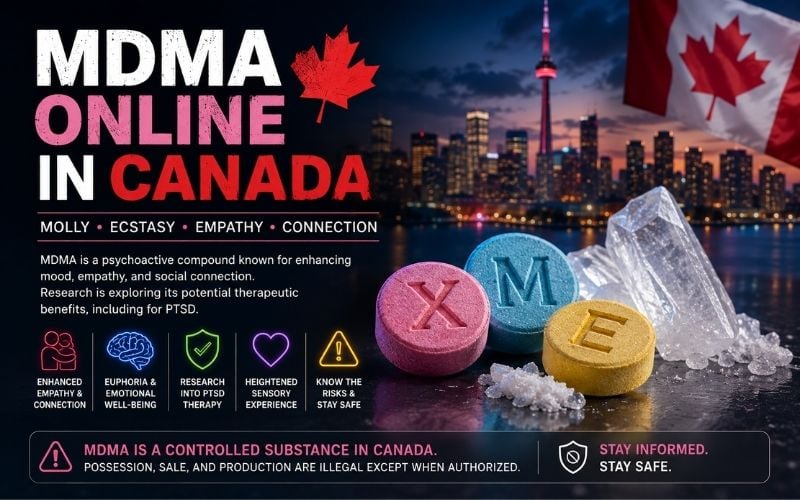
MDMA, commonly known as Molly or Ecstasy, is a psychoactive substance that has attracted significant attention for decades. It is associated with feelings of euphoria, increased sociability, emotional closeness, and heightened sensory experiences.
In recent years, MDMA has also received renewed attention because of research into its potential use alongside psychotherapy, particularly for post-traumatic stress disorder (PTSD).
At the same time, searches for terms such as “MDMA online Canada,” “buy MDMA Canada,” “Molly Canada,” and “Ecstasy Canada” have become increasingly common.
However, understanding MDMA requires more than looking at its recreational reputation or emerging research. Consumers should also understand its effects, potential risks, product uncertainty, and current Canadian legal status.
What Is MDMA?
MDMA stands for 3,4-methylenedioxymethamphetamine.
It is a psychoactive substance with both stimulant and psychedelic properties. MDMA affects several neurotransmitter systems in the brain, particularly serotonin, and can produce changes in mood, perception, energy, and social interaction.
MDMA is commonly associated with names such as:
- Molly
- Ecstasy
- E
- X
- MDMA
These names do not necessarily tell you what a particular product actually contains.
This is particularly important with illicit products because substances sold as “Molly” or “Ecstasy” may contain other drugs or unexpected compounds.
Health Canada notes that tablets sold as MDMA can vary in their contents and that official-looking logos or markings do not establish what is actually inside a product.
Why Is MDMA Sometimes Called Molly or Ecstasy?
Ecstasy is a name historically associated with MDMA tablets, while Molly is commonly used to describe purportedly crystalline or powdered MDMA.
These terms are often used interchangeably in popular culture, but there is an important distinction between the name of a substance and the actual contents of an illicit product.
A product sold under a particular street name is not automatically verified to contain pure MDMA.
This is one of the reasons why unregulated psychoactive substances can present significant risks.
What Effects Can MDMA Produce?
MDMA can affect people differently.
Health Canada reports that short-term effects can include feelings of pleasure, well-being, increased energy, sociability, friendliness, and closeness with others.
Other possible effects include:
- Increased heart rate
- Increased blood pressure
- Sweating
- Nausea
- Vomiting
- Jaw clenching or teeth grinding
- Blurred vision
- Changes in perception
- Anxiety
- Confusion
- Paranoia
- Panic
- Hallucinations
The experience can also change as the effects wear off. Some people may experience fatigue, low mood, anxiety, confusion, or difficulty concentrating afterward.
Why Do People Associate MDMA With Empathy and Connection?
MDMA has developed a reputation for producing feelings of emotional openness and social connection.
The substance influences serotonin and other neurotransmitter systems involved in mood and social behavior.
This has contributed to interest in MDMA-assisted psychotherapy, where researchers are investigating whether carefully controlled MDMA administration combined with structured psychotherapy could have therapeutic value.
However, the clinical setting is very different from recreational use.
Clinical research involves controlled conditions, carefully selected participants, medical oversight, standardized substances, and defined therapeutic protocols.
It should not be assumed that recreational MDMA produces the same outcomes as MDMA used in a clinical trial.
MDMA and PTSD Research
One of the biggest reasons MDMA has returned to public discussion is research into post-traumatic stress disorder.
Researchers have investigated MDMA-assisted psychotherapy as a potential treatment approach for people with PTSD.
Canadian clinical trial records continue to show active research involving MDMA-assisted therapy for PTSD. For example, Canada’s clinical trial portal lists Phase 2 and Phase 3 studies investigating MDMA-assisted therapy for PTSD.
These studies are important because they examine MDMA in controlled medical and therapeutic environments.
Research findings should not be interpreted as evidence that taking illicit MDMA outside a clinical setting provides the same therapeutic benefits.
Is MDMA Approved as a Treatment in Canada?
Health Canada states that there are currently no approved therapeutic products containing MDMA in Canada.
That distinction is important.
MDMA is being researched for potential therapeutic applications, but research participation and medical approval are not the same thing.
Some clinical trials can legally involve controlled substances under specific regulatory conditions. Health Canada also has specific exemptions relating to participants in authorized clinical trials involving MDMA or psilocybin.
These research pathways should not be confused with general consumer access.
Is MDMA Legal in Canada?
MDMA is a controlled substance in Canada.
Health Canada identifies MDMA as a restricted drug and states that activities involving it are prohibited unless specifically authorized under Canadian law and applicable regulations.
This means an online listing does not automatically make a product legal.
Health Canada specifically states that licensed companies cannot sell controlled substances to the general public over the internet. It also warns that illegal online vendors may provide products that are untested, unregulated, or unsafe.
Therefore, anyone searching for MDMA online in Canada should understand that online availability does not equal legal authorization.
Why Buying MDMA Online Can Be Risky
One of the biggest concerns with illicit online MDMA is uncertainty about what the product actually contains.
A product advertised as MDMA may contain:
- MDMA
- Another stimulant
- A synthetic cathinone
- Other psychoactive compounds
- Multiple substances
- Unknown contaminants
Health Canada notes that substances sold as MDMA can be mixed with other drugs, including stimulants and novel psychoactive substances.
This makes product claims from an unauthorized seller difficult to verify.
A photograph, product description, logo, or customer review cannot reliably establish the chemical composition of an illicit substance.
MDMA and Physical Health Risks
MDMA can produce significant physical effects.
It can increase heart rate and blood pressure and can raise body temperature.
These effects can become particularly concerning in environments involving intense physical activity, dancing, crowds, or high temperatures.
Health Canada also warns about risks associated with dehydration and electrolyte imbalance. Drinking excessive amounts of water can itself create dangerous electrolyte disturbances.
Other potential complications can include:
- Severe overheating
- Seizures
- Cardiovascular problems
- Liver or kidney damage
- Loss of consciousness
- Dangerous interactions with other substances
The severity of an adverse reaction can vary substantially between individuals.
MDMA and Mental Health Risks
Although MDMA is often associated with positive emotions, it can also produce difficult psychological effects.
Possible effects include:
- Anxiety
- Panic
- Confusion
- Paranoia
- Depression
- Hallucinations
- Sleep disruption
- Problems concentrating
Some effects can persist after the main experience has ended.
Health Canada also reports that repeated MDMA use can be associated with longer-term mental and physical effects.
MDMA Interactions With Other Substances
Combining MDMA with other drugs can increase the risks.
This includes combinations involving:
- Other stimulants
- Alcohol
- Cannabis
- Antidepressants
- Other psychoactive substances
- Certain prescription medications
Health Canada has reported serotonin syndrome in association with MDMA use alongside certain medications, including some antidepressants.
Because individual medications and health conditions vary, people should speak with a qualified healthcare professional about potential drug interactions rather than relying on online information.
Why Online MDMA Listings Should Be Treated Carefully
The internet can make controlled substances appear more accessible than they legally are.
A website may display:
- Product photographs
- Prices
- Strain or product names
- Purity claims
- Customer reviews
- Delivery promises
- Laboratory-testing claims
None of these automatically establishes that the product is legal, authentic, or safe.
Health Canada explicitly warns that illegal online vendors may sell untested and unregulated products.
For controlled substances, the difference between online availability and legal access is especially important.
MDMA Research vs. Recreational MDMA
It is useful to separate these two topics.
Recreational MDMA
Recreational use generally occurs outside medical supervision and involves substances obtained through unauthorized channels.
The composition and strength of illicit products can be uncertain.
Clinical MDMA Research
Clinical research uses controlled protocols and medical oversight.
Researchers can control factors such as:
- Participant eligibility
- Substance identity
- Administration procedures
- Clinical monitoring
- Therapeutic environment
- Follow-up assessments
This controlled environment is fundamental to evaluating whether MDMA-assisted therapy can be safe and effective for particular conditions.
What Is MDMA-Assisted Therapy?
MDMA-assisted therapy is an investigational approach combining MDMA administration with psychotherapy.
The basic concept is not simply taking MDMA and expecting therapeutic benefits.
Instead, researchers investigate whether MDMA’s psychological effects can be incorporated into a structured therapeutic process.
Canadian clinical trial records continue to include research into MDMA-assisted therapy for PTSD, demonstrating that this remains an active area of investigation.
However, it remains important to distinguish an investigational therapy from an approved treatment.
Common Questions About MDMA in Canada
What is MDMA?
MDMA is a psychoactive compound known chemically as 3,4-methylenedioxymethamphetamine. It is commonly associated with the names Molly and Ecstasy.
Is MDMA legal in Canada?
MDMA is a controlled substance, and sale, possession, and production are prohibited unless specifically authorized under Canadian law.
Can I legally buy MDMA online in Canada?
Health Canada states that licensed companies cannot sell controlled substances to the general public over the internet. Unauthorized online vendors may be operating illegally and may sell untested or unsafe products.
Is MDMA being studied for PTSD?
Yes. Canadian clinical trial records include studies investigating MDMA-assisted therapy for PTSD.
Is MDMA approved as a PTSD treatment in Canada?
Health Canada states that there are currently no approved therapeutic products containing MDMA in Canada.
What is Molly?
“Molly” is a common street name for MDMA, although products sold under that name may not necessarily contain what they claim to contain.
What is Ecstasy?
Ecstasy is another common name associated with MDMA, particularly when referring to tablets sold in recreational settings.
Final Thoughts
MDMA remains one of the most widely discussed psychoactive substances, partly because of its association with euphoria, empathy, and social connection and partly because of continuing research into its potential therapeutic applications.
For Canadians, however, it is essential to understand the difference between scientific research, recreational use, and legal access.
MDMA remains a controlled substance in Canada, and unauthorized sale, possession, and production are illegal. Online vendors selling controlled substances to the public are not providing a legal retail pathway.
At the same time, legitimate clinical research into MDMA-assisted therapy continues, particularly in relation to PTSD.
For anyone researching MDMA online in Canada, the most useful starting point is reliable information about the substance, its potential effects and risks, ongoing research, and Canadian regulations rather than relying on online sales claims.