Get Free Express Shipping when you place an order over $150





R-Isomer Ketamine: Effects, Research, Risks & What to Know

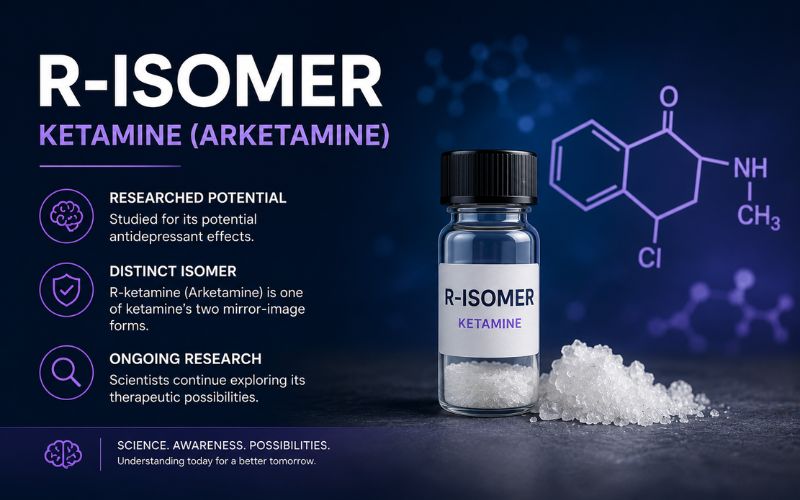
As interest in psychedelic-assisted therapies and ketamine research continues growing in Canada, more people are searching for information about R-Isomer Ketamine, also known as R-ketamine or arketamine.
Many users researching “R-Isomer” are trying to understand:
- What R-ketamine is
- Differences between R-ketamine and S-ketamine
- Potential effects
- Mental health research
- Duration and dissociative experiences
- Ketamine stereoisomers explained
- Risks and safety considerations
- Legal status in Canada
This educational guide explains the science, research, effects, and current discussions surrounding R-Isomer ketamine in simple and helpful language.
What Is R-Isomer Ketamine?
Ketamine exists in two mirror-image molecular forms called enantiomers:
- R-ketamine (Arketamine)
- S-ketamine (Esketamine)
Standard ketamine is commonly a mixture of both forms, known as racemic ketamine. Researchers continue studying how each isomer may affect the brain differently.
R-ketamine is often discussed in scientific literature because some studies suggest it may potentially produce antidepressant effects with fewer dissociative or psychotomimetic side effects compared to S-ketamine.
Understanding Ketamine Isomers
The “R” and “S” labels describe the molecule’s spatial orientation or “handedness.”
Racemic Ketamine
Contains both R and S forms in a 50/50 mixture.
S-Ketamine (Esketamine)
Associated with:
- Stronger anesthetic potency
- More intense dissociative effects
- Medical nasal spray formulations such as Spravato
R-Ketamine (Arketamine)
Currently being researched for:
- Potential antidepressant effects
- Longer-lasting mood benefits
- Reduced psychotomimetic side effects in some studies
Scientific reviews explain that ketamine’s stereoisomers may interact differently with NMDA receptors and other neurological pathways.
Why Is R-Ketamine Getting Attention?
Researchers and psychedelic communities have shown increasing interest in R-ketamine because of early research suggesting it could potentially offer therapeutic benefits with reduced hallucination-like side effects compared to S-ketamine.
Some studies indicate R-ketamine may:
- Produce longer-lasting antidepressant effects
- Cause fewer dissociative experiences
- Have lower psychotomimetic intensity in research settings
However, research is still ongoing, and many questions remain unanswered.
How Does R-Isomer Ketamine Affect the Brain?
Ketamine primarily affects the glutamate system in the brain through NMDA receptor modulation. It may also influence:
- Neuroplasticity
- Synaptic connectivity
- Mood regulation pathways
- Brain-derived neurotrophic factor (BDNF)
Researchers continue studying how R-ketamine may differ neurologically from S-ketamine. Some animal studies suggest stronger antidepressant effects with fewer behavioral abnormalities.
Potential Effects Associated With Ketamine
Ketamine compounds are generally associated with:
- Dissociation
- Altered perception
- Mood changes
- Euphoria
- Sedation
- Sensory distortion
- Dream-like states
According to Health Canada, ketamine can also produce hallucinations, detachment from the body, confusion, and impaired coordination.
Experiences may vary significantly depending on:
- Dosage
- Environment
- Mental state
- Individual sensitivity
- Method of use
How Long Do Ketamine Effects Last?
Duration depends on:
- Dose
- Route of administration
- Individual metabolism
Educational resources generally describe ketamine experiences as:
- Fast onset
- Short-to-moderate duration
- Dissociative in nature
Some effects may begin within minutes and last up to approximately 60–90 minutes depending on use patterns.
R-Ketamine vs S-Ketamine
| Feature | R-Ketamine | S-Ketamine |
| Also Known As | Arketamine | Esketamine |
| Research Interest | Antidepressant potential | Approved medical applications |
| Dissociative Intensity | Potentially lower | Often stronger |
| Clinical Availability | Experimental/research | Medical nasal spray exists |
| Duration Discussions | Sometimes described as longer-lasting | Shorter but more potent |
Research remains ongoing, and many findings are still preliminary.
Common Misconceptions About “R-Isomer” Ketamine
Online psychedelic communities frequently discuss confusion around ketamine isomers.
Reddit discussions often point out that:
- Most street ketamine is racemic
- Pure R-ketamine is uncommon outside research settings
- Many claims about “R-isomer ketamine” may be inaccurate
One Reddit user explained:
“RACEMIC MEANS A MIXTURE OF S(+) AND R(-).”
Another discussion noted that pure R-ketamine is rarely available publicly and that many online claims are difficult to verify.
These discussions highlight the importance of education and harm reduction awareness.
Potential Risks & Side Effects
Ketamine compounds can carry significant risks.
Psychological Risks
Possible concerns include:
- Anxiety
- Panic reactions
- Confusion
- Hallucinations
- Dissociation
- Memory disruption
Physical Risks
Potential side effects may include:
- Elevated heart rate
- Increased blood pressure
- Nausea
- Dizziness
- Sedation
- Coordination impairment
Health Canada also warns that high doses may cause respiratory depression, unconsciousness, or overdose risks.
Mental Health & Ketamine Research
Ketamine-related research continues expanding globally in areas such as:
- Treatment-resistant depression
- PTSD studies
- Suicidal ideation research
- Anxiety disorders
- Chronic pain research
In Canada, ketamine is legally used medically under regulation, and Spravato (esketamine nasal spray) received approval for certain treatment-resistant depression cases.
However, R-ketamine itself remains largely experimental and under investigation.
Is R-Ketamine Legal in Canada?
Ketamine is regulated under Canada’s Controlled Drugs and Substances Act.
Health Canada states that unauthorized possession, sale, or production of ketamine is illegal outside approved medical, scientific, or industrial contexts.
Anyone researching ketamine-related compounds should understand the legal framework and risks involved.
Harm Reduction & Responsible Education
If researching psychedelic or dissociative compounds, consider:
- Learning from credible sources
- Understanding dosage risks
- Avoiding unknown substances
- Prioritizing mental health awareness
- Researching legal implications
- Understanding set and setting
Education and harm reduction remain essential in psychedelic discussions.
FAQs About R-Isomer Ketamine
1. What is R-Isomer ketamine?
R-Isomer ketamine, also called arketamine, is one of the two mirror-image forms of ketamine.
2. What is the difference between R-ketamine and S-ketamine?
R-ketamine is being researched for potentially longer-lasting antidepressant effects with fewer dissociative side effects, while S-ketamine is currently used in approved medical treatments.
3. Is R-ketamine legal in Canada?
Ketamine is regulated in Canada and generally illegal outside authorized medical or scientific use.
4. Is pure R-ketamine commonly available?
Many online discussions suggest pure R-ketamine is rare outside research environments.
5. What are ketamine’s common effects?
Effects may include dissociation, sensory distortion, mood changes, hallucinations, and altered perception.
6. How long does ketamine last?
Effects may last roughly 45–90 minutes depending on the route of use and dosage.
7. Why is ketamine being researched for depression?
Researchers are exploring ketamine’s rapid effects on mood, neuroplasticity, and treatment-resistant depression.
8. What is racemic ketamine?
Racemic ketamine contains both R-ketamine and S-ketamine in equal proportions.
Final Thoughts
R-Isomer ketamine has become an increasingly discussed topic within psychedelic and mental health research communities. While early scientific studies suggest potential therapeutic promise, many aspects of R-ketamine remain experimental and under investigation.
Anyone researching ketamine-related compounds should prioritize:
- Evidence-based information
- Harm reduction awareness
- Mental health considerations
- Legal understanding
- Responsible education
As psychedelic science continues evolving in Canada and worldwide, informed decision-making remains essential for anyone exploring these conversations further.For more psychedelic education and ketamine-related resources, visit Elevated You – R-Isomer Collection