


Blog
LSD in Canada: Effects, Research, Risks and Legal Status

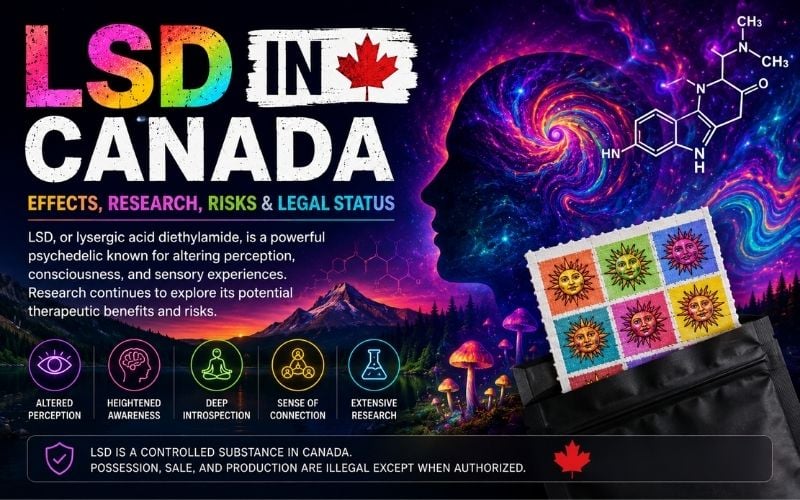
LSD is one of the best-known psychedelic substances in the world. Also called acid, LSD stands for lysergic acid diethylamide, a powerful psychoactive compound known for producing significant changes in perception, mood, sensory experiences, and consciousness.
For decades, LSD has been associated with music, art, creativity, psychology, and research into human consciousness. More recently, renewed interest in psychedelic science has brought LSD back into discussions about neuroscience, mental health, and the potential therapeutic applications of psychedelic substances.
For Canadians researching LSD online in Canada, however, it is important to look beyond descriptions of psychedelic experiences. Understanding LSD also means understanding its effects, potential risks, ongoing research, and Canadian legal status.
What Is LSD?
LSD is a potent psychedelic substance that can significantly alter a person’s perception of reality.
Unlike ketamine, which is generally classified as a dissociative anesthetic, LSD belongs to the group commonly known as classic psychedelics. Psilocybin and DMT are other well-known substances in this category.
LSD can influence perception, thoughts, emotions, sensory experiences, and a person’s sense of time.
The experience can vary substantially from one person to another.
Factors such as individual psychology, surroundings, expectations, other substances, and the actual composition of a product can all influence the experience.
Why Is LSD Associated With Psychedelic Experiences?
LSD is particularly known for its ability to produce profound changes in consciousness.
People may experience:
- Changes in visual perception
- Altered sense of time
- Intensified colors and patterns
- Changes in thought processes
- Heightened emotional experiences
- Introspection
- Distorted perception of sounds and surroundings
- Feelings of connection or altered self-awareness
However, psychedelic experiences are not necessarily positive.
Some people can experience anxiety, panic, confusion, paranoia, or frightening changes in perception.
This is one reason why descriptions of LSD as simply a tool for creativity or self-discovery can provide an incomplete picture.
How Long Do LSD Effects Last?
LSD is known for having a relatively long-lasting psychedelic experience.
The duration can vary depending on several factors, including the substance, individual physiology, and circumstances.
Because the experience can last for many hours, someone experiencing unexpected psychological effects may have to deal with them for an extended period.
This long duration is an important difference between LSD and some other psychoactive substances.
It also means that claims suggesting LSD is simply a short-lived recreational experience can be misleading.
LSD and Creativity
LSD has a long cultural association with creativity.
Artists, musicians, writers, and researchers have historically discussed psychedelics in relation to imagination, perception, and creative thinking.
This connection has contributed significantly to LSD’s place in popular culture.
However, personal anecdotes about creativity should not be confused with scientific evidence.
Research into psychedelics and creativity is still developing, and the effects can vary between individuals and circumstances.
LSD and the Study of Consciousness
One reason LSD has remained scientifically interesting is its ability to dramatically alter ordinary conscious experience.
Researchers can use psychedelic states to investigate questions such as:
- How does the brain construct perception?
- How does the brain create a sense of self?
- Why does our perception of time change?
- How do sensory inputs become conscious experiences?
- What happens to normal patterns of brain activity during psychedelic states?
These questions make LSD particularly interesting from a neuroscience perspective.
Psychedelic research is increasingly examining how changes in brain activity correspond with subjective changes in consciousness.
LSD and Mental Health Research
The renewed interest in psychedelics has also encouraged researchers to revisit LSD’s potential therapeutic applications.
Scientists have investigated psychedelics in relation to conditions including depression, anxiety, substance-use disorders, and other mental health conditions.
However, research into LSD should be distinguished from established medical treatment.
Evidence from a research study does not mean that an individual can safely reproduce the same results outside a controlled clinical environment.
Clinical studies generally involve carefully selected participants, standardized substances, professional supervision, monitoring, and structured protocols.
LSD vs. Psilocybin
LSD and psilocybin are often discussed together because both are classic psychedelics.
However, they are different substances.
| LSD | Psilocybin |
|---|---|
| Synthetic psychedelic | Naturally occurring psychedelic compound found in certain mushrooms |
| Commonly known as acid | Commonly associated with magic mushrooms |
| Produces significant changes in perception and consciousness | Produces psychedelic changes in perception and consciousness |
| Long history of scientific and cultural interest | Increasing research interest in therapeutic applications |
| Controlled substance in Canada | Psilocybin is also controlled in Canada |
The similarities between the two substances should not obscure their pharmacological differences.
LSD vs. MDMA
LSD and MDMA are sometimes grouped together because both have played a role in psychedelic culture.
They are pharmacologically different.
LSD is a classic psychedelic primarily associated with altered perception and consciousness.
MDMA is generally described as a psychoactive substance with stimulant and empathogenic properties.
The experiences, risks, mechanisms, and research surrounding the two substances are therefore different.
What Are the Potential Risks of LSD?
LSD can produce unpredictable psychological effects.
Possible difficult effects include:
- Anxiety
- Panic
- Paranoia
- Confusion
- Agitation
- Distorted perception
- Increased heart rate
- Increased blood pressure
- Nausea
- Difficulty distinguishing perceptions from reality
A particularly difficult psychedelic experience is sometimes referred to as a bad trip.
While the term is informal, the underlying experience can be genuinely distressing.
People with certain mental health vulnerabilities may also face greater risks from psychedelic substances.
Why Product Uncertainty Matters
One of the biggest concerns surrounding illicit psychedelic products is uncertainty about their contents.
A product marketed online as LSD cannot automatically be assumed to contain LSD.
Illicit substances may contain unexpected compounds or different amounts of active ingredients than advertised.
This creates an important distinction between the name used to market a product and its actual chemical composition.
For this reason, online product descriptions, photographs, reviews, and seller claims should not be treated as laboratory verification.
Is LSD Addictive?
LSD is different from many substances commonly associated with physical dependence.
However, that does not mean it is completely risk-free.
Repeated psychedelic use can lead to tolerance, meaning that the effects may become weaker with repeated use over a short period.
Psychological reactions can also be significant, particularly when someone has an underlying vulnerability to certain psychiatric conditions.
The absence of conventional physical dependence should therefore not be interpreted as an absence of potential harm.
LSD and Flashbacks
Some people report experiencing recurring visual or perceptual disturbances after using LSD.
These experiences have historically been discussed under the term hallucinogen persisting perception disorder (HPPD).
HPPD is uncommon, but it is an important example of why psychedelic substances should not be treated as risk-free.
Anyone experiencing persistent changes in perception after taking a psychoactive substance should seek appropriate medical advice.
Is LSD Legal in Canada?
LSD is a controlled substance in Canada.
Unauthorized possession, production, trafficking, and other activities involving controlled substances can have legal consequences.
The fact that an online website advertises LSD does not mean that purchasing or possessing the substance is legally authorized.
Canadian laws and regulations can change, so people should consult official Canadian government resources for the most current information rather than relying on online sellers or social media posts.
Why Searching for LSD Online Requires Caution
Search engines can make almost any substance appear readily available.
A website may claim to offer:
- LSD
- Acid
- LSD blotters
- LSD products
- Psychedelic products
- LSD delivery in Canada
But online availability is not the same as legal availability.
Unauthorized sellers may also provide inaccurate information about product contents, strength, purity, or safety.
This makes independent verification particularly difficult.
LSD and the Future of Psychedelic Research
Interest in psychedelic research has expanded considerably in recent years.
Researchers are examining how psychedelic substances interact with the brain and whether carefully controlled psychedelic experiences could eventually contribute to new approaches to mental healthcare.
LSD remains part of the historical and scientific foundation of psychedelic research.
At the same time, current research should be interpreted carefully.
A promising scientific finding does not automatically establish a substance as a safe or approved treatment.
The future of psychedelic medicine will depend on continued clinical research, regulatory decisions, safety studies, and a better understanding of which patients may benefit from particular approaches.
Frequently Asked Questions About LSD in Canada
What is LSD?
LSD, or lysergic acid diethylamide, is a potent classic psychedelic that can significantly alter perception, consciousness, emotions, and sensory experiences.
What is LSD commonly called?
LSD is commonly known as acid. Other names may be used in informal or recreational settings, although terminology does not confirm the actual contents of a product.
Is LSD a psychedelic?
Yes. LSD is considered a classic psychedelic, alongside substances such as psilocybin and DMT.
Is LSD legal in Canada?
LSD is a controlled substance in Canada. Unauthorized activities involving LSD can be illegal.
Is LSD being researched?
Yes. LSD has a long history of scientific research, and psychedelic science continues to investigate how substances such as LSD affect perception, consciousness, and mental health.
Is LSD the same as magic mushrooms?
No. LSD and psilocybin mushrooms are different substances, although both are classified as classic psychedelics.
Is LSD the same as MDMA?
No. LSD is a classic psychedelic, while MDMA has stimulant and empathogenic properties and is pharmacologically different.
Can LSD have negative effects?
Yes. LSD can cause anxiety, panic, paranoia, confusion, impaired judgment, and other psychological or physical effects.
Can an online LSD product be trusted?
An online listing does not establish the identity, composition, purity, or legal status of a product. Unauthorized psychedelic products may contain unexpected substances.
Final Thoughts
LSD remains one of the most influential and extensively discussed psychedelic substances in modern history.
Its impact can be seen across neuroscience, psychology, music, art, and popular culture. Renewed interest in psychedelic research has also encouraged scientists to investigate questions about consciousness and potential therapeutic applications.
But curiosity about LSD should be balanced with accurate information.
For Canadians researching LSD online, it is particularly important to distinguish between online marketing, scientific research, medical treatment, and Canadian law.
LSD can produce powerful changes in perception and consciousness, and those effects can be unpredictable. Understanding both the potential and the risks provides a more realistic picture than promotional descriptions alone.
As psychedelic research continues to develop, LSD will likely remain an important subject in discussions about consciousness, neuroscience, and the future of psychedelic science. Order now from elevatedyou.