


Blog
DMT Benefits: What Research Says About Its Potential Effects

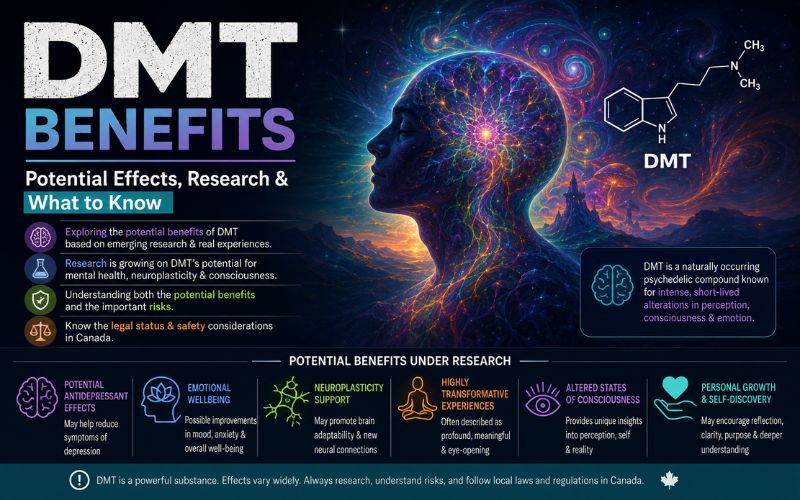
DMT has become one of the most discussed compounds in modern psychedelic research. Known for producing an intense alteration in perception and consciousness, DMT has also attracted scientific interest for a different reason: researchers are investigating whether its effects could have therapeutic value.
The conversation around DMT is often filled with dramatic claims. Some people describe profound personal experiences, while others focus on its potential relationship with depression, emotional wellbeing, neuroplasticity, and consciousness.
But what does the research actually tell us?
The answer is promising, but it is still developing.
This guide explores the potential benefits of DMT, what researchers have discovered so far, what remains uncertain, and why DMT is becoming an important subject in psychedelic science.
What Is DMT?
DMT stands for N,N-dimethyltryptamine, a psychedelic compound belonging to the tryptamine family.
It occurs naturally in several plants and is also associated with ayahuasca, a traditional plant-based preparation used in parts of South America.
DMT acts primarily through serotonin-related systems in the brain and can produce substantial changes in perception, emotions, thoughts, sensory processing, and one’s sense of self.
Unlike some longer-lasting psychedelics, DMT is generally associated with a relatively short period of intense psychedelic effects when administered through certain routes.
That combination of high intensity and relatively short duration is one reason researchers are interested in its possible therapeutic applications.
What Are the Potential Benefits of DMT?
It is important to make one distinction before discussing benefits.
DMT is not an established treatment for depression or other medical conditions simply because clinical research has produced encouraging findings. Research is still ongoing, and many studies have involved relatively small groups of participants.
With that in mind, several potential areas of benefit are being investigated.
1. Potential Antidepressant Effects
One of the most interesting areas of DMT research is depression.
A 2025 phase 2a clinical trial investigated vaporized DMT in people with treatment-resistant depression. Researchers reported rapid reductions in depressive symptoms, with improvements observed after treatment and maintained in follow-up assessments. The study was relatively small, so the results need to be replicated in larger controlled trials.
More recently, a 2026 randomized, placebo-controlled phase IIa trial investigated intravenous DMT in adults with moderate-to-severe major depressive disorder. The researchers reported a significantly greater reduction in depression scores two weeks after DMT compared with placebo, with effects observed for up to three months in the subsequent open-label phase.
These findings are among the reasons DMT has attracted attention as a potential fast-acting psychedelic intervention for depression.
However, research findings should not be interpreted as proof that DMT is an appropriate treatment for everyone experiencing depression.
2. Potential Effects on Anxiety and Overall Wellbeing
Researchers are also examining whether DMT experiences may influence anxiety and broader measures of wellbeing.
A 2026 study involving healthy participants and people with treatment-resistant depression reported reductions in state anxiety after inhaled DMT and improvements in measures including life satisfaction and quality of life. The study followed participants for different periods depending on the group and was open-label, meaning it did not use a placebo-controlled design. The authors therefore describe the findings as promising but acknowledge important limitations.
This is an interesting development because it expands the conversation beyond simply asking whether psychedelic compounds reduce symptoms.
Researchers are increasingly examining whether psychedelic interventions may affect broader aspects of psychological wellbeing.
3. Research Into Neuroplasticity
Another area receiving attention is neuroplasticity.
Neuroplasticity describes the brain’s ability to adapt and change in response to experiences and environmental factors.
Laboratory research has suggested that psychedelic compounds can influence biological pathways associated with neuronal growth and plasticity. DMT is being studied in this context because researchers want to understand whether these biological effects could contribute to longer-lasting changes following a psychedelic experience.
This does not mean that DMT automatically “repairs the brain” or makes the brain healthier.
The research is still trying to establish how laboratory findings translate into meaningful human outcomes.
That distinction is important when evaluating online claims about psychedelic “brain benefits.”
4. A Potentially Shorter Psychedelic Intervention
Duration is another reason DMT interests researchers.
Traditional psychedelic experiences can sometimes last for several hours. DMT can produce a much shorter acute experience depending on the method of administration.
From a clinical research perspective, a shorter intervention could potentially make psychedelic-assisted treatment easier to study and integrate into controlled clinical environments.
Researchers are therefore investigating formulations and administration methods that could provide a carefully monitored psychedelic intervention without requiring an extremely long treatment session.
A 2026 review of registered DMT and ayahuasca clinical trials found that research is increasingly focused on controlled administration, safety, tolerability, formulation, and potential therapeutic applications.
5. Potential Changes in Emotional Processing
Psychedelics are also being investigated for their ability to influence the way people process emotions and personal experiences.
A psychedelic experience can sometimes cause people to look at familiar thoughts, emotions, or personal circumstances from a different perspective.
Researchers are interested in whether this temporary change in psychological perspective could contribute to longer-term therapeutic effects.
However, it would be inaccurate to say that DMT automatically produces emotional healing or personal growth.
The experience varies substantially between individuals, and researchers are still investigating exactly how psychological support, expectations, environment, and the psychedelic experience itself interact.
6. Greater Interest in Consciousness Research
DMT isn’t only being investigated for potential mental health applications.
It is also valuable to scientists studying human consciousness.
DMT can dramatically alter:
- Visual perception
- Time perception
- Sensory processing
- Self-awareness
- Emotional states
- Perception of one’s surroundings
- The sense of personal identity
These changes give researchers an unusual opportunity to investigate how the brain constructs conscious experience.
Questions surrounding consciousness remain some of the biggest unanswered questions in neuroscience.
DMT provides researchers with one possible tool for studying what happens when ordinary patterns of perception and self-awareness are temporarily disrupted.
7. Reports of Mystical or Meaningful Experiences
Many people who discuss DMT describe their experiences using words such as:
- Spiritual
- Mystical
- Transformative
- Profound
- Connected
- Meaningful
- Otherworldly
Some report feeling a stronger sense of connection with themselves, other people, nature, or the universe.
These experiences can be personally meaningful.
However, there is an important distinction between having a meaningful subjective experience and scientifically proving that the experience represents an external spiritual reality.
Research can study the psychological characteristics of these experiences, but personal interpretations remain individual.
Why Do People Describe DMT Experiences as Transformative?
The intensity of a psychedelic experience may temporarily disrupt familiar ways of thinking.
Some people report questioning long-held assumptions or looking at personal circumstances from a new perspective.
This may lead to feelings of:
- Personal insight
- Emotional clarity
- Increased appreciation
- Connectedness
- Curiosity
- Reflection
- Changes in personal priorities
But these outcomes aren’t guaranteed.
A psychedelic experience can also be confusing, frightening, or emotionally difficult.
This is why responsible discussions of DMT should include both potential positive experiences and possible challenges.
DMT and Depression: What Does the Research Actually Show?
This is one area where it is particularly important to distinguish research from marketing.
Recent clinical trials have produced encouraging findings.
A 2025 phase 2a study of vaporized DMT in treatment-resistant depression reported rapid and sustained reductions in depressive symptoms.
A separate 2026 randomized placebo-controlled trial also reported a significant reduction in depression scores following a single DMT intervention with supportive psychotherapy, with effects persisting during follow-up.
However, these studies don’t mean DMT is already an approved mainstream treatment for depression.
The research field is still relatively young.
A 2025 systematic review examining early-phase clinical trials highlighted the limited number of available studies and the need for additional research.
So the most accurate description is:
DMT shows promising early evidence for potential antidepressant effects, but further large-scale research is required.
DMT and Quality of Life
Researchers are beginning to look beyond traditional symptom measurements.
A 2026 study examined anxiety, life satisfaction, and quality-of-life measures following inhaled DMT in healthy participants and people with treatment-resistant depression.
The researchers reported improvements across several measures, including aspects of quality of life among the participants with depression. However, the study was open-label and involved a relatively small sample, so the results should be considered preliminary.
This type of research is important because mental health is about more than the absence of symptoms.
Future psychedelic research may increasingly examine:
How people function, connect, feel, and experience their everyday lives.
Is DMT the Same as 5-MeO-DMT?
No.
This is an important distinction when researching psychedelic products or scientific studies.
N,N-DMT and 5-MeO-DMT are different compounds.
They belong to the broader tryptamine family but have different pharmacological characteristics and can produce different subjective effects.
Research involving 5-MeO-DMT should therefore not automatically be used to make claims about N,N-DMT.
If you read a study about “DMT,” check the exact compound being investigated before applying its findings elsewhere.
DMT vs. Psilocybin
DMT and psilocybin are both psychedelic compounds, but they aren’t the same.
DMT
DMT is a tryptamine psychedelic associated with intense alterations in consciousness and perception.
Psilocybin
Psilocybin occurs naturally in certain mushroom species and is converted by the body into psilocin.
Both substances interact with serotonin systems, but their pharmacology, experiences, duration, and research applications differ.
This is why research involving psilocybin should not automatically be presented as evidence about DMT.
What Are the Risks of DMT?
Potential benefits should always be considered alongside potential risks.
DMT can cause substantial changes in perception and consciousness.
Possible effects may include:
- Anxiety
- Confusion
- Fear
- Disorientation
- Changes in heart rate
- Changes in blood pressure
- Intense emotional reactions
- Altered perception of time and space
- Hallucinatory experiences
A 2025 systematic review of early DMT clinical trials found increases in blood pressure and heart rate at higher exposures, although these effects generally resolved relatively quickly in the reviewed studies.
Clinical research takes place under controlled conditions with screening and monitoring.
That is very different from assuming that an unregulated product or unsupervised experience carries the same level of safety.
Why Set and Setting Matter
One of the most discussed concepts in psychedelic research is set and setting.
“Set” refers broadly to a person’s psychological state, expectations, and mindset.
“Setting” refers to the surrounding environment and circumstances.
The same psychedelic substance can be experienced very differently depending on these factors.
This is one reason modern clinical psychedelic studies use carefully controlled environments and trained professionals rather than treating psychedelic compounds as ordinary recreational products.
Is DMT Addictive?
DMT does not fit neatly into the traditional pattern associated with substances such as nicotine or opioids.
However, that doesn’t mean there are no risks associated with psychedelic use.
The psychological intensity of the experience, potential adverse reactions, and uncertainty surrounding unregulated products remain important considerations.
People should also avoid assuming that a substance is risk-free simply because it does not produce a conventional pattern of physical dependence.
Is DMT Legal in Canada?
For Canadian readers, legality is an important consideration.
N,N-DMT is listed in Schedule III of Canada’s Controlled Drugs and Substances Act.
This means DMT is a controlled substance under Canadian federal law.
Canada is also updating its controlled-substance regulatory framework. Health Canada states that new Controlled Substances Regulations were published on December 17, 2025 and are scheduled to replace the current regulations on October 1, 2026.
Because regulations can change, anyone researching DMT in Canada should rely on current information from Health Canada and federal legislation rather than assuming that an online product listing establishes legal authorization.
What Does Current DMT Research Tell Us?
The overall picture is becoming clearer.
Researchers have found evidence suggesting that DMT may have potential in several areas, particularly:
- Depression research
- Anxiety and wellbeing
- Quality-of-life outcomes
- Consciousness research
- Neuroplasticity research
- Psychedelic-assisted therapy research
At the same time, the research has limitations.
Many clinical studies are relatively small, and some are open-label rather than placebo-controlled.
A 2026 scoping review of registered DMT and ayahuasca clinical trials described the field as active and developing, while noting that much of the research remains focused on safety, tolerability, psychedelic effects, and early-stage therapeutic investigation.
In other words, DMT research is promising, but it is not finished.
Frequently Asked Questions About DMT Benefits
What are the main potential benefits of DMT?
Current research is investigating potential antidepressant effects, changes in anxiety and wellbeing, quality-of-life outcomes, neuroplasticity, and altered states of consciousness. These potential benefits remain under investigation.
Can DMT help with depression?
Early clinical trials have reported promising reductions in depressive symptoms, including findings from a 2026 randomized placebo-controlled trial. However, more research is needed before definitive conclusions can be made about its role in depression treatment.
Does DMT permanently change your brain?
There is research investigating psychedelic-related neuroplasticity, but claims that DMT permanently “rewires” or “repairs” the brain go beyond what current evidence establishes.
Why do people describe DMT as spiritual?
DMT can produce extremely unusual changes in perception, identity, and consciousness. Some people interpret these experiences spiritually or mystically, although those interpretations are subjective.
Is DMT the same as 5-MeO-DMT?
No. They are different compounds and should not be treated as interchangeable when reading research or product information.
Is DMT legal in Canada?
DMT is currently listed as a Schedule III controlled substance under Canada’s Controlled Drugs and Substances Act.
Are the benefits of DMT scientifically proven?
Some early clinical findings are encouraging, particularly in depression research, but DMT’s therapeutic benefits have not been conclusively established across conditions. Larger and longer-term studies are still needed